The short answer
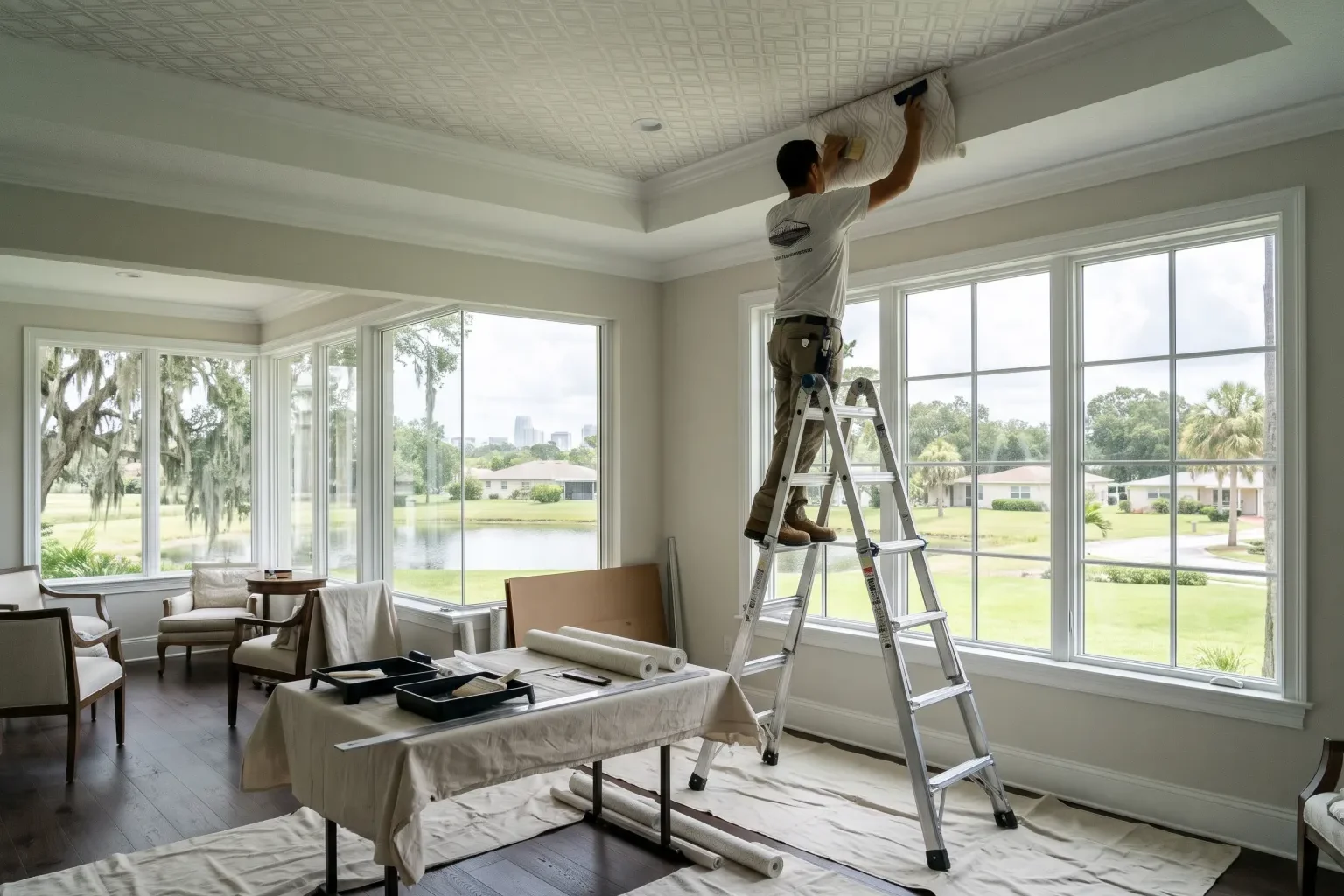
Ceiling wallpaper suits rooms with a clear overhead view, like dining rooms, powder rooms and bedrooms. We level and prime the ceiling, plan the strip direction and pattern from the main entry, and hang with staging so seams stay tight and trim lines stay crisp.
Papering a ceiling is sometimes called decorating the fifth wall, and it is one of the most striking changes you can make to a room. A subtle metallic texture overhead warms up a dining room at night, a small-scale botanical print makes a powder room feel finished, and a soft pattern above a nursery crib gives a child something to look at. It is also the hardest place in a house to hang paper. Every strip is fighting gravity, the installer is working above their head, and any flaw in the surface is lit by the ceiling fixture. We take on ceiling projects across Orlando and nearby communities, and we approach them with more preparation and more patience than any wall job.
Rooms Where a Papered Ceiling Makes Sense
The best ceilings for paper are ones people actually look up at. Dining rooms with a chandelier, small powder rooms where the ceiling is close, bedrooms where you lie looking up, home offices and reading nooks all qualify. A pattern overhead can also make a tall, boxy room feel cozier, or draw attention to a tray or coffered ceiling.
There are also places we usually steer people away from. Full bathrooms with showers produce steam that collects on ceilings, and even with good ventilation that moisture can lift seams over time. Ceilings with active roof leaks or recent water stains need repairs first. And popcorn texture, still common in many Orlando ranch homes from the 1960s and 1970s, must be removed and the surface smoothed before paper can go up. Older popcorn coatings can contain asbestos, so testing comes before any scraping.
Preparing a Ceiling to Hold Paper
Gravity punishes weak adhesion, so ceiling prep is more demanding than wall prep. We start by protecting the floor and furniture completely, then take down light fixtures or loosen their canopies, and remove smoke detector heads and vent covers where it is safe to do so.
Next we examine the surface in raking light. Drywall seams that have cracked or popped nail heads, common in houses that shift through Florida's wet and dry seasons, get re-secured and refinished. Textured ceilings are scraped or skim coated to a smooth plane. Flat ceiling paint is often porous and chalky, so we follow with a quality wallpaper primer that seals the surface and gives the adhesive something firm to grab.
We also pick the adhesive carefully. Many ceiling jobs call for a heavier, higher-tack paste than the same paper would need on a wall, and some lightweight papers are more forgiving overhead than heavy ones.
- Remove or loosen fixtures, vents and detectors
- Repair cracks, nail pops and water-stained areas
- Remove texture and skim coat where needed
- Prime with a product that suits both the ceiling and the paper
Step by Step: Hanging Paper Overhead
On a ceiling, there is no floor to work up from and no corner you can count on being square, so the layout plan comes first.
We measure the ceiling in both directions and decide which way the strips should run. Shorter strips are easier to control, so we often run across the narrow dimension. Then we decide where the pattern should read correctly, usually from the main doorway, and where a centered motif should sit relative to the light fixture.
A chalk or laser line is snapped for the first strip, because ceiling edges in older homes often wander. Strips are cut with allowance at both ends, pasted, and folded accordion-style so they can be unfolded a section at a time. Working from a stable platform rather than a single ladder, we press each section into place along the line, smoothing as we go.
Each following strip is matched to the pattern of the one before and butted tight; seams are rolled gently. Where the ceiling meets the wall, we trim to a crisp line or, if the walls are also papered, plan the junction so the two meet cleanly. Around fixture boxes we make small relief cuts, trim to the opening and leave room for the canopy to cover the edge. Finally, every surface gets wiped free of paste before it dries.
What Drives the Cost of a Ceiling Job
Ceiling work typically takes longer per square foot than wall work, and the gap widens with these factors:
- Surface condition: smooth sealed drywall is quickest, while popcorn removal or repairs add a full stage
- Paper choice: heavy or delicate papers, grasscloth and metallics need extra handling overhead
- Pattern repeat: large repeats and strong geometric patterns require precise alignment across every strip
- Room size and height: vaulted or tall ceilings in two-story homes need scaffolding
- Features: tray edges, beams, fans and recessed lights all add cuts and time
Caring for a Papered Ceiling
Ceilings collect less grime than walls, so care is light. Keep the room air-conditioned while the paste cures, which matters in July and August when a warm, closed house can feel like a sauna. Run bathroom fans if the room is near a shower, and avoid hanging anything from the ceiling until the paper has fully dried.
Dust occasionally with a soft, long-handled duster. If a ceiling fan wobbles or a fixture needs replacing later, have it handled carefully so the paper around the canopy is not torn. Should a seam ever lift, it can usually be re-adhered with seam paste and light rolling.